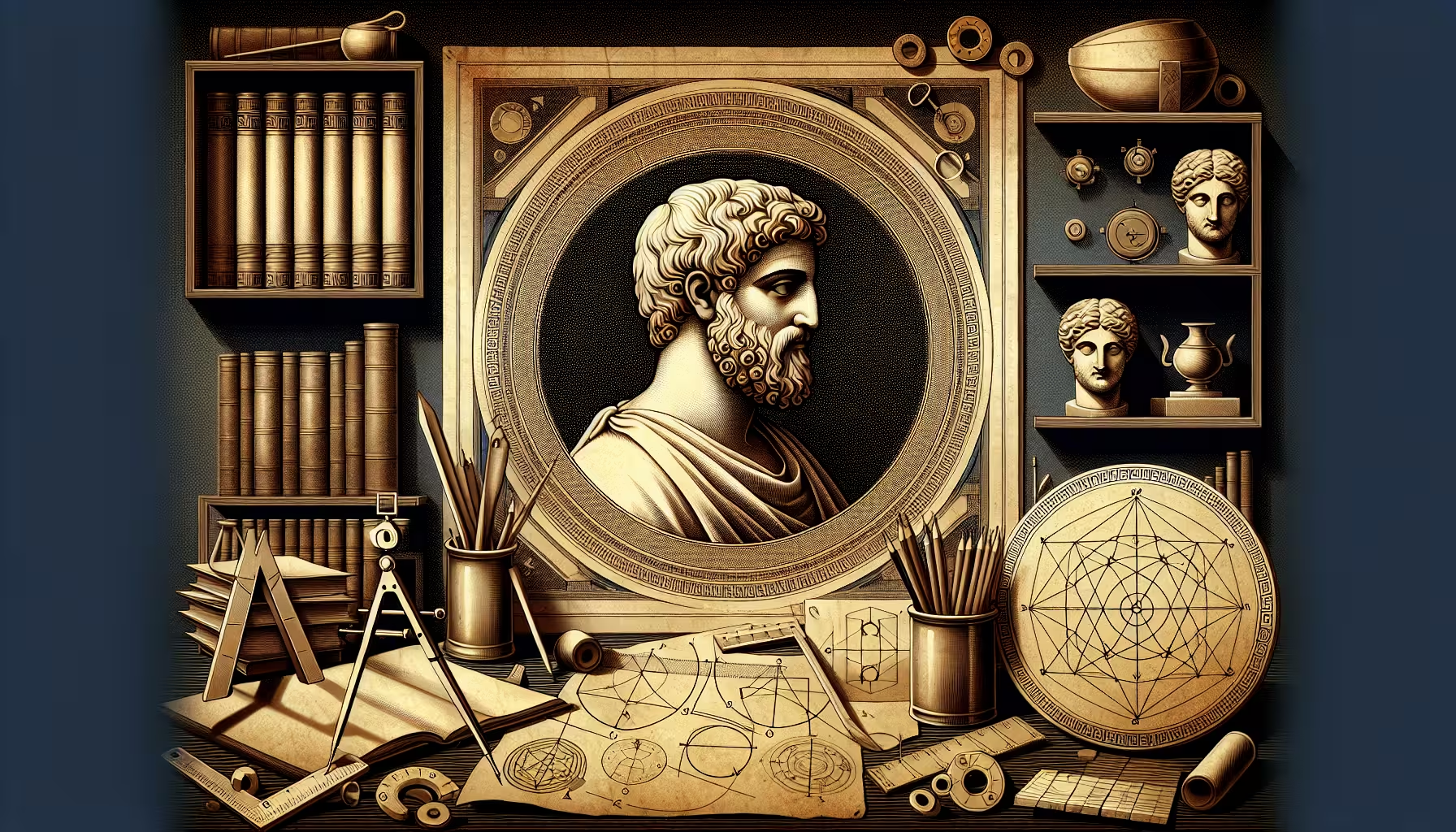
Euclid, known as the ‘Father of Geometry’, was a legendary figure in the world of mathematics and is revered for his groundbreaking contributions to the field. His most famous work, “Elements”, is one of the most influential and widely studied mathematical texts of all time. Euclid’s systematic approach to geometry and his development of the fundamental principles and theorems laid the groundwork for the entire field of geometry. His legacy continues to inspire mathematicians and students alike, making Euclid a truly significant and legendary figure in the history of mathematics. Hook: Discover the legendary figure whose work laid the foundation for the entire field of geometry and continues to
Introduction
In the ancient city of Alexandria, in the 3rd century BC, there lived a mathematician and scholar whose work would shape the very foundations of geometry and mathematics for centuries to come. His name was Euclid, and he is known as the ‘Father of Geometry’ for his seminal work in the field. Euclid’s life and work took place during a time of great intellectual and cultural flourishing in ancient Greece and Egypt. His contributions to mathematics and geometry were not only groundbreaking in his own time, but they also laid the groundwork for much of the scientific and mathematical knowledge that followed. Euclid’s most famous work, “Elements,” is a comprehensive compilation of geometrical knowledge, including definitions, postulates, and theorems, presented in a logical and systematic manner. This work not only became the standard textbook for the study of geometry for over 2,000 years, but it also had a profound influence on the development of mathematical thought and the scientific method. Euclid’s work in geometry and mathematics has left an indelible mark on the history of science and has been instrumental in shaping our understanding of the world around us. His influence can be seen in fields ranging from architecture and engineering to physics and astronomy. As we delve into the life and work of Eu
Euclid, known as the ‘Father of Geometry’, lived around 300 BCE in ancient Greece. He wrote a series of 13 books called “Elements” that became the most important mathematical work of all time, laying out the principles of geometry and shaping the way we understand space and shape.
“Discover the Legacy of Euclid: The Father of Geometry”
Discover the Legacy of Euclid: The Father of Geometry Euclid, a mathematician born in Ancient Greece, is known as the ‘Father of Geometry’ for his foundational work in the field. His renowned work, “Elements,” is a comprehensive compilation of mathematical knowledge and the principles of geometry, which has been widely influential in shaping the study of mathematics for centuries. Euclid’s logical and systematic approach to geometry, expressed in his systematic use of definitions, axioms, and proofs, has laid the groundwork for the development of mathematics as we know it today. An enduring figure in the history of mathematics, Euclid’s contributions have left an indelible mark on the world of geometry and continue to inspire scholars and mathematicians. His legacy serves as a reminder of the enduring impact of intellectual curiosity and dedication in the pursuit of knowledge. Euclid’s influence has transcended time, making him a figure of profound significance in the world of mathematics.
“Unraveling the Legacy of Euclid: The Father of Geometry”
Unraveling the Legacy of Euclid: The Father of Geometry Euclid is known as the ‘Father of Geometry’ for his foundational work in the field. Born in 300 BC, Euclid was a Greek mathematician who revolutionized the study of geometry with his seminal work, “Elements.” This groundbreaking book, consisting of 13 volumes, laid down the fundamental principles of geometry and served as a comprehensive guide for mathematicians for centuries to come. Euclid’s systematic and logical approach to geometry not only established him as a pioneer in the field but also set the standard for mathematical rigor and clarity. His influence extended far beyond his lifetime, shaping the way in which mathematics is taught and understood today. Euclid’s name has become synonymous with geometric principles and his legacy continues to inspire mathematicians and educators alike.
Unveiling the Legacy of Euclid: The Father of Geometry and His Timeless Influence on Mathematics
Unveiling the Legacy of Euclid: The Father of Geometry and His Timeless Influence on Mathematics In the world of mathematics, one name stands out above all others: Euclid. Known as the ‘Father of Geometry,’ Euclid’s contributions to the field are nothing short of monumental. Born in ancient Greece around 300 BC, Euclid’s groundbreaking work in geometry laid the foundation for much of modern mathematics. His magnum opus, “Elements,” is a comprehensive compilation of the mathematical knowledge and theories of his time, covering topics such as number theory, plane geometry, and solid geometry. Euclid’s meticulous and logical approach to mathematics earned him the title of “The Great Geometer,” and his influence can still be felt centuries later. With his timeless influence, Euclid stands as a testament to the enduring impact of dedication and passion in the world of mathematics.
Did you know that Euclid, who is known as the “Father of Geometry,” was a Greek mathematician who lived around 300 BC? His most famous work, “Elements,” is a comprehensive compilation of geometrical and mathematical knowledge that became the standard textbook for teaching mathematics for over 2,000 years. Euclid’s systematic and logical approach to geometry laid the groundwork for the development of the field and earned him the title of the “Father of Geometry.” His work also had a major impact on the development of mathematics and science throughout history.
Read more:
euclid-the-father-of-geometry-from-alexandriaeuclid-master-of-mathematics-and-geometry
the-master-of-geometry-euclids-elements
euclids-elements-the-masterpiece-of-mathematics
euclids-lasting-legacy-in-mathematics-and-geometry
https://www.britannica.com/biography/Euclid-Greek-mathematician